
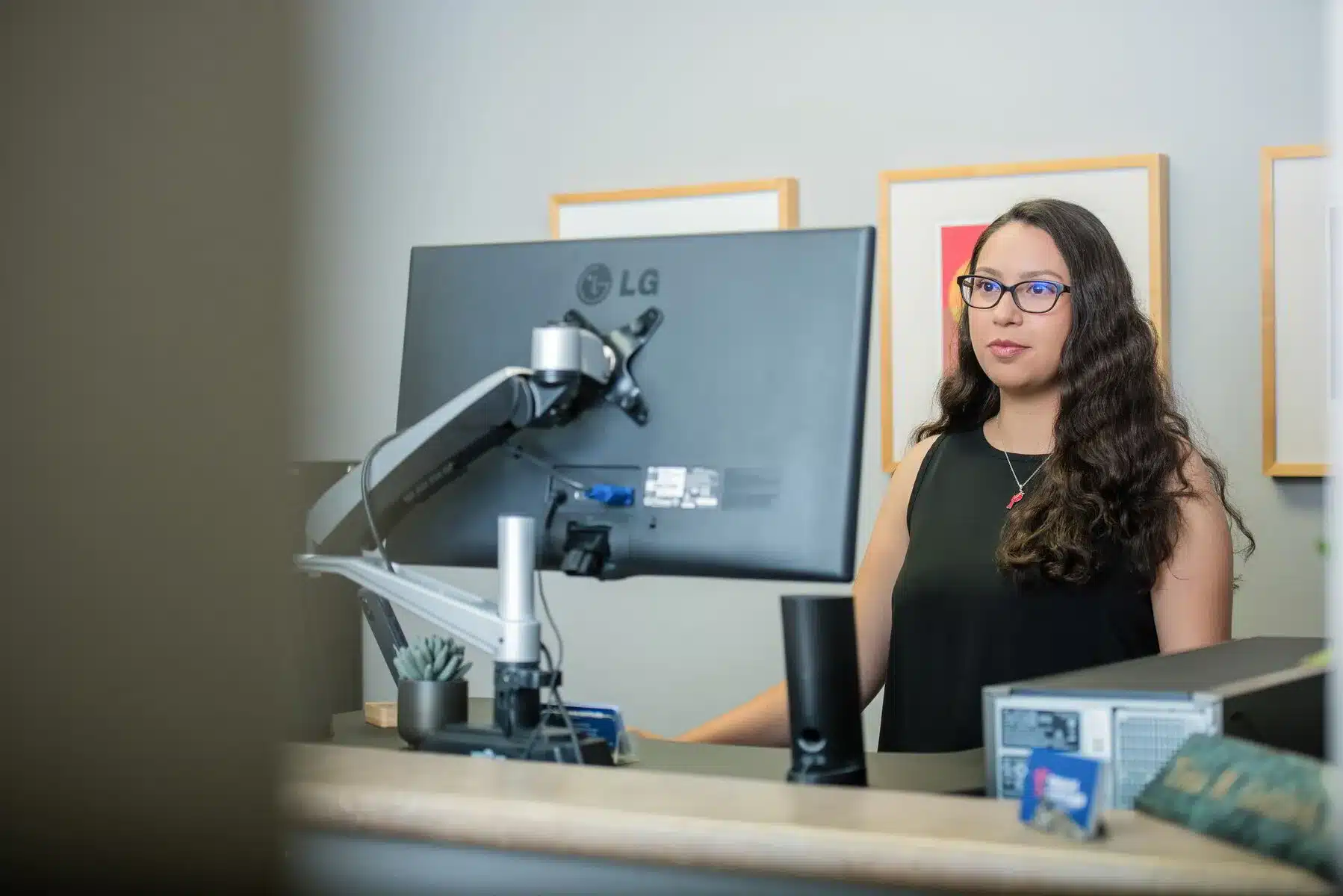
Let’s Not Sugarcoat This
Your body is either being supported by your daily habits, or it is being worn down by them.
Ergonomics is not about fancy office chairs or expensive desk setups. It is about creating an environment that allows your body to function the way it was designed to function, so your work does not sabotage the life you are trying to build.
Because here is what I know to be true:
You cannot create, lead, serve, parent, perform, or enjoy your life fully if your body is constantly fighting your setup.
Poor ergonomics can lead to pain, fatigue, tension, headaches, poor focus, and long-term wear on your spine and nervous system. Good ergonomics helps you think more clearly, feel more energized, move better, and protect your body for the long game.
This is about success longevity.
It is about being able to do what you love, how you want, for as long as possible.
So let’s walk through the basics.
1. Your Chair Matters
Your chair matters more than most people think.
One size does not fit all. If you are 5’2″, you should not be sitting in the same chair setup as someone who is 6’2″. Your body needs support that actually fits your frame.
Here is what to look for:
-
Your feet should rest flat on the floor, or on a footrest if needed.
-
Your thighs should be parallel to the ground.
-
Your knees should sit around a 90-degree angle.
-
Your back should fully contact the chair, especially the lumbar support.
-
You should not be perched on the edge of the seat.
-
You should not feel like you are sliding forward all day.
If the seat is too deep, your body will compensate. If it is too shallow, you will not get the support you need. Either way, your spine pays the price.
Some gaming chairs can actually be great ergonomic options. Many are built in size-specific models, which can make them surprisingly helpful for shorter or taller bodies.
The key is adjustability.
Height. Lumbar support. Armrests. Seat depth.
Your chair should fit you. Not the other way around.
2. Your Keyboard, Mouse, and Monitor Need to Work With Your Body
Once your chair is dialed in, your tools need to come into alignment.
Your keyboard and mouse should be positioned so your elbows stay close to your body, around 90 degrees. No reaching. No shrugging. No working with your shoulders up by your ears.
Your monitor should sit with the top of the screen at or slightly below eye level.
That keeps your neck in a more neutral position.
If you use multiple monitors, keep them at the same height. Your primary monitor should be directly in front of you, and your secondary monitors should be angled slightly inward.
Here is the thing: bigger is not always better.
Ultra-large monitors can create excessive neck rotation if your eyes and head are constantly scanning too far from side to side. Your setup should help your body stay centered, not force it into constant compensation.
Keep frequently used items close enough that you do not have to twist, reach, or overextend all day.
Your phone. Your notebook. Your printer. Your water.
Tiny stressors repeated all day become patterns your body has to manage.
3. Sitting All Day is Not Neutral
We have all heard the phrase “sitting is the new smoking.”
And while that line can feel dramatic, the truth behind it matters.
Extended sitting creates real stress on the body, even if you exercise regularly. Sitting for long periods can contribute to back pain, neck tension, reduced circulation, low energy, metabolic issues, and increased health risks over time.
The answer is not to stand all day.
The answer is to move more.
Your body was designed for variation. Sitting, standing, walking, shifting, stretching, and resetting.
Movement is the goal.
4. Standing Workstations Can Be a Game Changer
A standing desk or sit-stand converter can completely change how your body feels throughout the day.
When you can move between sitting and standing, your body gets relief from one static position. Your circulation improves. Your energy often improves. Your focus can improve. A lot of people even think more clearly when they are standing or moving.
Some people like to alternate every 20 to 30 minutes. Others sit for deep thinking and stand for lighter tasks, calls, or routine work.
There is no one perfect formula.
The win is that you are no longer trapped in one position for eight hours straight.
For laptops, this matters even more. A laptop on a desk usually forces your head downward. Use a riser to bring the screen up, then pair it with an external keyboard and mouse.
That one shift can make a massive difference.
And this applies to kids too.
Homework stations matter. Screens should be at eye level when possible. Slouching after school for hours is still stress on the spine, even when they are young.
Small habits become lifelong patterns.
5. Your Phone Is Training Your Neck
Let’s talk about text neck.
Most people are no longer cradling landline phones between their ear and shoulder, but now we have a different problem. We are constantly looking down at cell phones.
Your head weighs around 10 to 12 pounds in a neutral position. As your head tilts forward, the effective load on your neck increases dramatically.
At 15 degrees forward, your neck may be managing around 27 pounds of pressure.
At 30 degrees, around 40 pounds.
At 60 degrees, which is common when texting, around 60 pounds.
That is not nothing.
And when you repeat that posture all day, every day, your muscles, joints, discs, and nervous system have to adapt.
The fix is simple, but it requires awareness.
Bring your phone up to eye level. Use speakerphone, headphones, or a stand when possible. Take breaks. Stretch. Reset your posture.
Your phone should not be quietly training your body into dysfunction.
6. Ergonomics Does Not Stop at Your Desk
This is bigger than your office.
Ergonomics is everywhere.
It is in your car. Your seat position. Your mirrors. Your steering wheel. Your commute posture.
It is in service-based work. Hygienists, hairdressers, practitioners, drivers, and anyone who uses their body repetitively need to pay attention to posture, tools, and setup.
It is in your home. Your TV height. Your couch. Your favorite reading chair. Your laptop habits.
If your TV is mounted too high, your neck is paying for it.
If your couch swallows you and forces your spine into a collapsed position, your body is paying for it.
If you curl up with your laptop and stare down for hours, your nervous system is paying for it.
This is not about being obsessive.
It is about becoming aware.
Because the way you do ordinary things becomes the way your body lives.
7. Why Ergonomics Matters
Good ergonomics is not about having the perfect setup.
It is about protecting your ability to live well.
To work with focus.
To move without constant stiffness.
To serve at a high level.
To have fun.
To think clearly.
To make your impact without your body constantly asking you to slow down.
After decades of helping people with spine and nervous system issues, I can tell you this with certainty: so many problems are preventable.
Not all of them. But a lot of them.
And prevention is powerful.
Your body is the vehicle for everything you are here to do. Your work, your relationships, your leadership, your creativity, your joy, your legacy.
So start with one change today.
Adjust your chair.
Raise your monitor.
Move every 30 minutes.
Stop staring down at your phone.
Set up your laptop properly.
One shift creates momentum.
Your future self will thank you.
And your spine absolutely will too.
Take That First Step
If you need some guidance on where to start, call our office at 951-699-5161 for a one on one consultation with Dr. Tina Gottlieb. Your fill out our contact form here.
You deserve to feel great so that you can live a life full of possibilities.