
When vertigo and headaches happen at the same time, it can feel like your entire world has been thrown off balance.
The room may spin. Your head may hurt. You may feel unsteady, foggy, nauseated, or unsure whether you can get through a normal day without another episode.
Many people begin asking the same question:
Does vertigo cause headaches?
Vertigo, dizziness, headaches, and migraines often appear together. Sometimes the headaches have been present for years before the dizziness begins. Other times, vertigo shows up first and the headaches follow.
In my 30 years of experience as an upper cervical chiropractor, it is about fifty-fifty.
But figuring out which symptom came first is not always the most important question.
The more useful question may be:
Is there an underlying issue contributing to both symptoms?
At Possibilities Chiropractic, we often see people from Temecula, Murrieta, Menifee, and surrounding communities who are experiencing more than one problem at a time. Vertigo, dizziness, headaches, and migraines are among the most common reasons patients have come to see me during my 30 years as an upper cervical chiropractor.
For some people, an overlooked piece of the puzzle may be the upper cervical spine—the top two bones in the neck.
Why Do Vertigo and Headaches Happen Together?
The body is designed to regulate, adapt, and respond to the world around it.
Ideally, it does this in a steady and balanced way.
However, when the body becomes stuck in a fight-or-flight pattern, its ability to adapt may become less consistent. Instead of responding smoothly, the body can begin swinging more dramatically.
Patients may experience combinations of symptoms such as:
- Vertigo or dizziness
- Headaches
- Migraines
- Neck discomfort
- Difficulty feeling steady
- A sense that the body is not regulating normally
When there is an issue in the upper cervical spine, it may affect more than the neck itself. That is one reason headaches, migraines, and dizziness so often appear together in the patients we evaluate.
This does not mean every case of vertigo or every headache originates in the neck.
Your vision and ears are both important areas to have examined, and many of our patients have already seen an optometrist, their primary care provider, or other health care professionals before visiting us.
But if those evaluations have not provided the full answer, looking at the upper cervical spine may reveal another important layer.
The Missing Piece of the Puzzle
Health is not always a two-piece puzzle.
Sometimes it is a ten-piece puzzle.
A person may have already looked at their eyes, ears, medications, stress, sleep, nutrition, or other possible factors. Each one may be an important piece.
An upper cervical evaluation gives us the opportunity to look at a piece that is often missed.
We evaluate the top of the neck to determine whether there is a mechanical or nervous-system-related issue that could be contributing to the way the body is functioning.
When we find an upper cervical issue, it gives us something specific to address.
If progress is slower than expected, we continue looking at the smaller pieces that may also be adding to the problem.
These may include:
- Sleep quality
- Hydration
- Nutrition
- Pillow choice
- Workstation ergonomics
- Time spent looking down at a phone
- Hobbies and repetitive movements
- Previous injuries
The goal is not to chase one symptom.
The goal is to look at the whole person and give the body the best opportunity to function well.
Can Looking at Your Phone Make Vertigo or Headaches Worse?
Patients often notice that symptoms become more intense at certain times of day or after specific activities.
Long periods spent scrolling on a phone may increase symptoms for some people. The same may be true of poor sleep or sitting at a computer with the screen in the wrong position.
A laptop placed on a table, for example, may cause you to look downward for hours.
These habits are rarely the entire cause of the problem. But they can add fuel to a fire that is already burning.
That is why our conversations go beyond chiropractic adjustments.
We talk about whole-body wellness and the practical habits that may support healing and help protect progress.
Small changes may matter when the body is already struggling to adapt.
What Happens During an Upper Cervical Evaluation?
An upper cervical evaluation is designed to determine whether the top of the neck may be part of the bigger picture.
We begin by learning about your health history, symptoms, lifestyle, previous injuries, and the patterns you have noticed.
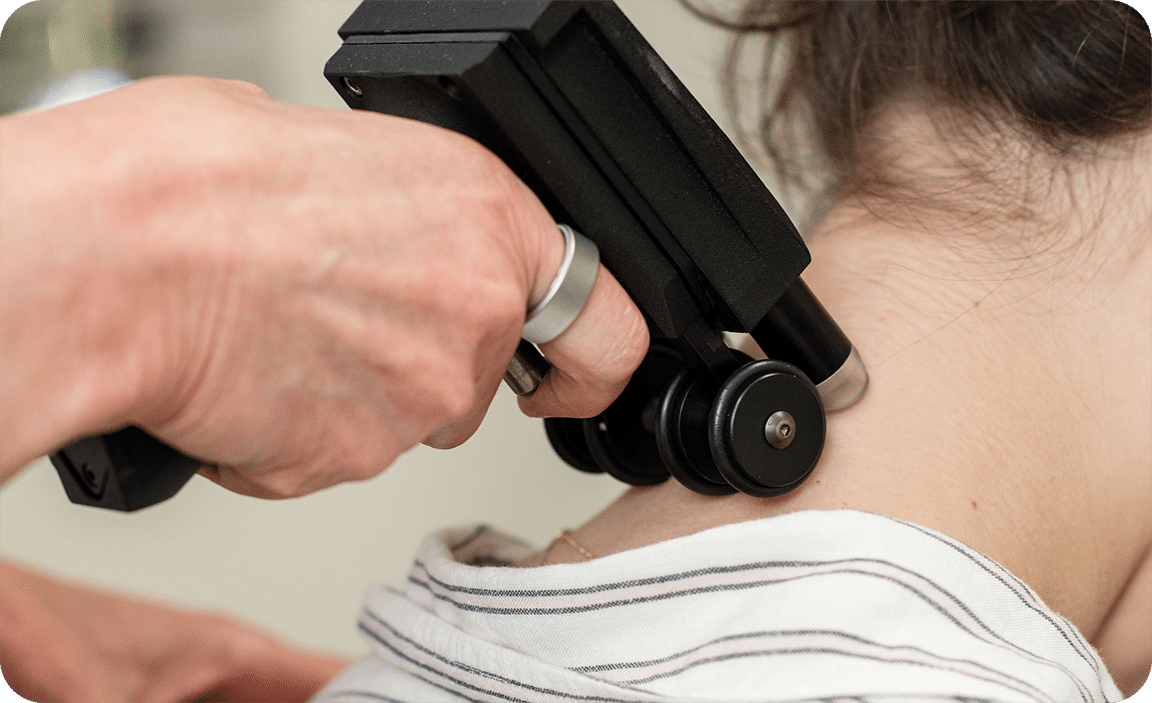
We may use testing such as spinal infrared thermography to look at how the body is regulating, digital range of motion tests, and precision x rays when indicated.
When appropriate, we use precision-based upper cervical adjustments rather than treating each symptom separately.
There is not one adjustment for vertigo and another adjustment for headaches.
The purpose of upper cervical chiropractic care is to identify an area of the spine that needs correction and make a precise adjustment. The body is then given an opportunity to adapt, regulate, and heal more effectively from within.
What Does Care for Vertigo and Headaches Look Like?
Patients who arrive with both vertigo and migraines or headaches may begin with a slightly more concentrated schedule of visits.
Although the overall protocol is like the one we use for other patients, we may add a few early visits to collect more information and see how the body begins to respond.
A patient may initially visit a few times a week for a couple of weeks.
During that time, we watch the data, monitor progress, and determine how well the body is adapting.
As the body responds, the frequency of care is reduced.
The purpose is not to adjust as often as possible. It is to provide care when needed while allowing the body time to do its work.
Every patient is different, and results and timelines vary.
The European Vacation That Almost Looked Completely Different
One patient stands out whenever I think about vertigo and headaches.
She came to see me two days before leaving for Europe.
This was not an ideal timeline.
Normally, I would prefer to have a couple of weeks to observe the data and see how a patient responds before they board a plane for a major international trip.
But this trip mattered deeply to her.
It was special time she had set aside with her husband, and she did not want vertigo and headaches to control the experience.
I had a decision to make.
After her initial visit, we moved forward with one adjustment.
Then she left for Europe.
When she returned about three weeks later, she told me that she had boarded the plane the next morning without dizziness. She had gone on to enjoy the trip she had imagined without vertigo or headaches slowing her down or interfering with that time with her husband.
Her experience is memorable because it happened after one adjustment.
That is not a promise that every person will have the same response. Most people need more time, monitoring, and care.
But I will always remember how grateful I felt that we moved forward.
For her, the decision helped make an important trip feel possible again.
What Can Affect the Upper Cervical Spine?
People do not always connect the neck with vertigo or headaches.
They think about their vision and their ears, which are both reasonable places to start.
What they may not consider are the injuries that can change how the upper cervical spine moves.
These may include:
- Car accidents
- Sports injuries
- Falls
- Childhood bicycle accidents
- Repetitive work injuries
- Hitting your head
- Years of smaller physical stresses
It does not always take one dramatic trauma.
A series of smaller incidents may also alter the mechanics of the upper cervical spine over time.
When that happens, the effects may spill into other areas of the body.
Should You See an Upper Cervical Chiropractor for Vertigo and Headaches?
An upper cervical evaluation does not replace appropriate medical, vision, or ear-related care.
It adds another piece to the puzzle.
If you have already explored other possible causes but still experience vertigo, dizziness, headaches, or migraines, the health of your upper cervical spine may be worth evaluating.
The purpose is to see whether there is something present that can be addressed and not to assume that the neck is responsible for every symptom.
Schedule a One on One Call With Dr. Tina
You do not have to decide by yourself whether upper cervical care belongs in your plan.
During a phone consultation, you can speak with Dr. Tina about:
- The vertigo, dizziness, headaches, or migraines you experience
- How long the symptoms have been present
- What seems to make them better or worse
- The evaluations and care you have already tried
- Whether an upper cervical evaluation may be an appropriate next step
Possibilities Chiropractic serves patients from Temecula, Murrieta, Menifee, and surrounding communities.
Click here to book a phone consultation with Dr. Tina to discuss whether upper cervical care might benefit you. Or call 951-699-5161 to book your consultation. Serving Temecula, Murrieta, Menifee, and beyond.